

 Add to cart:
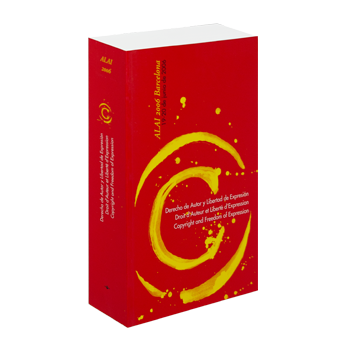
 Derecho de Autor y libertad de expresión / Droit d'auteur et liberté d'expression / Copyright and Freedom of Expression
VV.AA.
- Collection:
- 02. Lex
- Size:
- 15x23
- Pages:
- 802 Pages
- Language:
- Spanish / English / French
- Binding:
- Rústica
- ISBN:
- 978-84-935981-2-9
- Price (including VAT):
- Book : 80€
The 2006 ALAI Study Days examined the relationship between copyright and freedom of expression: how the two interact, feeding off and limiting one another, with both being contemplated in international conventions and treaties, such as the Universal Declaration of Human Rights (Articles 19 and 27) and the ICESCR.
The first section analyses the relationship between copyright and freedom of expression from both a historical and economic viewpoint, examining whether the traditional arguments justifying them remain valid and taking a closer look at the dualistic nature of copyright, acting as both the driving force behind and a brake on creativity (aware of the fact that, today, only this second aspect is given consideration). An in-depth analysis is carried out of the inherent limits contained within the copyright system to ensure subsequent creation and freedom of expression: the concept of the original work, the definition of exclusive rights and, especially, that of transfer, as well as the specific exceptions contained in countries’ national legislations. In the second part, attention is turned to a broader concept of freedom of access to culture as a requirement to create an environment in which creativity and freedom of expression can flourish. Two separate blocks examine some exceptions to copyright aimed at ensuring freedom of access and use (for informational, news, teaching, research and library purposes) and particularly their application in digital contexts (online libraries, press clipping services, blogs, etc.), as well as some instruments that are outside or ancillary to the field of copyright (such as contractual clauses and technology-based protection measures) that may prevent or restrict a freedom of access and use that is “guaranteed” (as the case may be) by internal limits. Finally, the third part covers freedom of expression in adjoining areas such as trademark and personality rights, to compare their solutions with those adopted in the field of copyright. The book also contains a CD-ROM that includes the complete text of the book, a list of those attending the Days, the questionnaire and the national reports.
Lionel Bently
Alberto Bercovitz
German Bercovitz Álvarez
Ramon Casas Vallés
Rochelle Cooper Dreyfuss
Graeme B. Dinwoodie
Elsa Deliyanni
Séverine Dusollier
Yves Gaubiac
Christophe Geiger
Ysolde Gendreau
Daniel Gervais
Agustín González
Lucie Guibault
Laurence Helfer
Marie-Christine Janssens
Tarja Koskinen-Olsson
Delia Lypszyc
André Lucas
Stefan Martin
Paolo Marzano
Pau Miserachs
Toyohiro Nomura
José de Oliveira Ascensão
Antoon Quaedvlieg
Jan Rosen
Christophe Seuna
Uma Suthersanen
Michel Vivant
Kozo Yabe


En Huygens Editorial
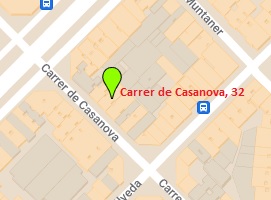
C/ Casanova 32, local - 08011 Barcelona
- © HUYGENS EDITORIAL
- |
- C/ Casanova, 32, local, 08011 Barcelona
- |
- Tel. (+ 34) 649 381 113
- |
- info@huygens.es
- |
- LEGAL NOTE